If you live in South Florida, your home’s air conditioning isn’t a luxury; it’s essential equipment. When that system starts making ominous noises, leaking refrigerant, or simply stops cooling, the immediate panic is rarely about the temporary heat. It’s about the cost.
You are faced with one of the most stressful financial decisions a homeowner can make:
Do I sink money into repairing an aging HVAC system, or do I bite the bullet and replace the entire unit?
There is no single "right" answer. However, there is a rational way to make this decision based on data, age, and efficiency, rather than emotion. At Cassidy Air Conditioning & Heating, we help Palm Beach County residents navigate this dilemma every day.
This comprehensive guide breaks down the financial, technical, and comfort factors that determine when to repair and when to replace your HVAC system, centered around our
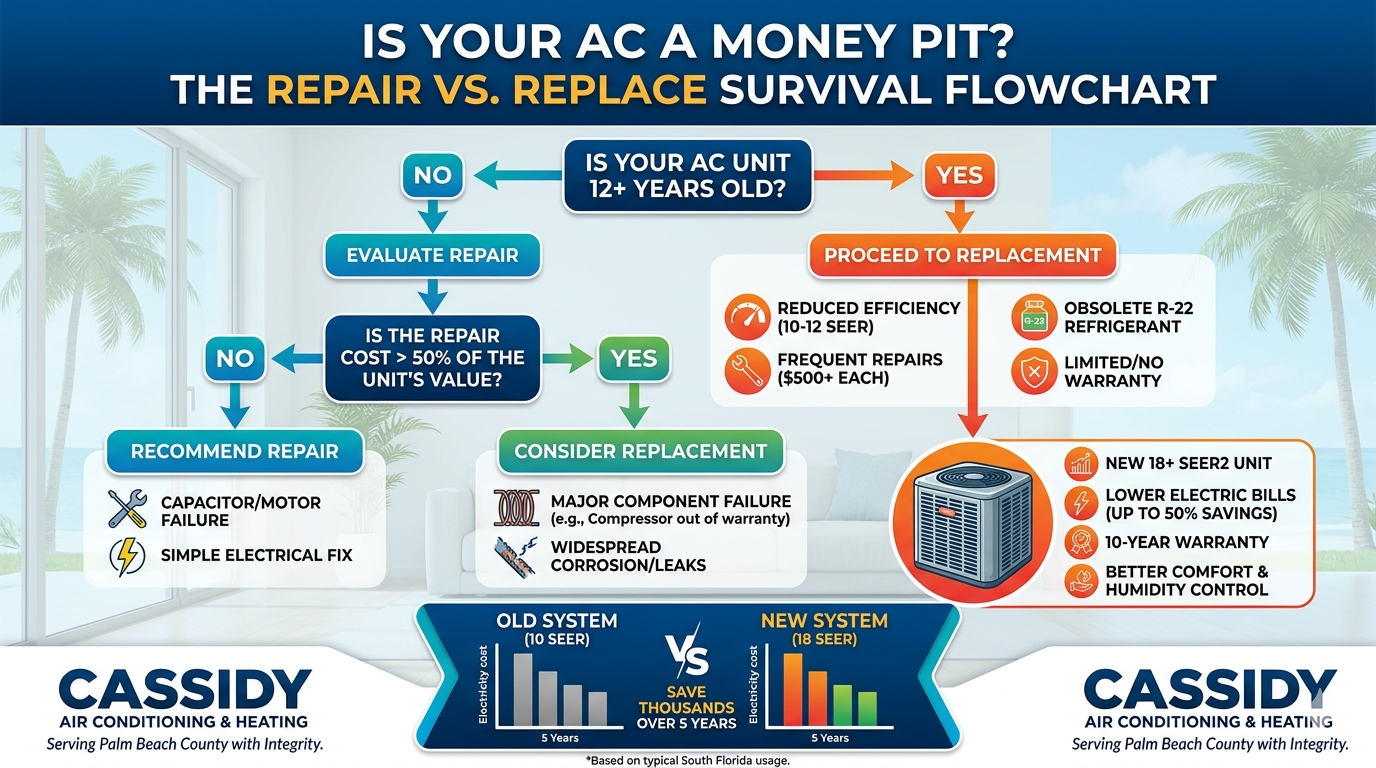
"A/C Survival Flowchart" below.
[INFOGRAPHIC PLACEHOLDER: The A/C Repair vs. Replace Survival Flowchart]
- Visual Description: A modern, clear flowchart. Start at "Is your AC 12+ years old?" If yes, follow the "Replace" path (focusing on efficiency gains). If no, proceed to "Is the repair cost > $1,500?" or "Are you facing the 50% Rule?" Clear visual indicators of savings, cost comparison (Old 10 SEER vs. New 18 SEER), and "Peace of Mind" factors.
The Variables that Matter: It’s More than Just the Price Tag
A common mistake is focusing solely on the immediate invoice. If a repair costs $600 and a new system is $7,000, the repair seems obvious. But if you have that $600 repair three times a year on a 15-year-old system, you are simply treating symptoms while the patient is dying.
To make an informed decision, you must consider four key variables:
1. The Age of the System (The Foundation)
In the harsh, humid, and salty environment of South Florida, an AC system’s lifespan is typically
10 to 15 years.
- 0-8 Years Old: Usually, these systems are worth repairing unless the failure is catastrophic (like a compressor failure out of warranty). Most parts are likely still under the manufacturer’s 10-year warranty (if properly registered).
- 8-12 Years Old: This is the "Yellow Zone." The component warranty may be expiring soon. The efficiency is already significantly lower than modern units. Repairs are often viable, but replacement should be considered if major components fail.
- 12+ Years Old: This is the "Red Zone." You are on borrowed time. The technology is likely obsolete, repair costs will escalate, and energy costs are much higher than they need to be.
2. The Total Cost of the Repair vs. The "50% Rule"
We advise homeowners to use the "50% Rule" (often referred to as the $5,000 Rule by some, though we prefer a percentage of value for modern systems).
- The Rule: If the cost of the repair exceeds 50% of the value of the entire system, replacement is almost always the smarter long-term financial move.
- The Calculation: You must factor in the current value. A 12-year-old system is worth a fraction of its replacement cost. If the unit is 12 years old and the repair is $2,000, you are likely spending more than 50% of that aged unit’s value on a temporary fix.
3. Energy Efficiency: What It’s Costing You Not to Upgrade
Your current AC unit’s efficiency is measured by its Seasonal Energy Efficiency Ratio (SEER or SEER2). The higher the number, the more cooling you get for your electricity dollar.
If your system is 12 years old, it likely operates at a 10 to 12 SEER rating. Modern, high-efficiency systems are commonly 16, 18, 20, or even higher SEER2.
- The Math: Upgrading from a 10 SEER unit to an 18 SEER unit in South Florida can result in
30% to 50% lower monthly electric bills. That is real money you are essentially "wasting" by keeping the old unit limping along. In a few years, those energy savings alone can pay a significant portion of the replacement cost.
4. Historical Reliability (The Frustration Factor)
Has your HVAC company become a close friend because they visit you three times every summer? Frequent, smaller repairs ($300-$500 each) add up to a significant financial burden (and immense frustration). If your system is experiencing its third leak in two years, the underlying infrastructure is compromised. The patches won’t hold forever.
Repair, Not Replace: When It Makes Sense
We will rarely suggest replacement if a system is healthy. These are the scenarios where a simple repair is your best option:
- The System is Less Than 8 Years Old: It’s in its prime. Even if a capacitor, motor, or contractor fails, the system’s core components still have years of life.
- The Problem is Simple and Isolated: A blown capacitor ($150-$250), a clogged condensate line ($100-$200), or a failed contactor ($150-$250) are simple electrical or maintenance fixes. They are not indicators of total system failure.
- The Part is Under Warranty: If a major component like the compressor ($1,500+ part) fails but is still under the 10-year manufacturer’s parts warranty, the decision to repair (paying only labor/refrigerant) is often the right move.
- You Plan to Sell the Home Very Soon: If you are moving within the next 12-24 months, you may not see the return on investment of a brand-new $7,000+ system. However, be aware that an aged, failing AC can affect your home inspection and resale value.
Replace, Not Repair: When It’s Time to Move On
According to our flowchart, the evidence is overwhelming in these scenarios:
1. The Age is the Defining Factor (12+ Years)
Even if the current repair is cheap ($300), an HVAC technician sees a system where the blower motor, condenser fan, and coils are all near the end of their design life. You fix one item only to have another fail 45 days later. It's a game of expensive whack-a-mole.
2. R-22 Refrigerant: The Obsolete Gas
If your system was installed before 2010, it almost certainly uses R-22 refrigerant (often called Freon). R-22 has been phased out completely due to environmental regulations.
While it is still possible to find recycled R-22, the price has skyrocketed. Recharging an R-22 system after a leak can cost $1,000 to $2,000 just for the gas, plus the cost to repair the leak. Investing that amount into a system that uses an obsolete, incredibly expensive gas is a financial mistake.
3. Major Component Failure Outside of Warranty
If the compressor (the heart of the system) or the condenser/evaporator coil (the lungs) fails on a unit older than 8-10 years and is out of warranty, the decision is made. A new compressor installation can cost $2,000-$3,500. A new coil replacement can be $1,500-$2,800. It is financially irrational to make these major repairs on an aged platform.
4. The System Cannot Provide Comfort
Sometimes the system "runs" but it does not cool. Your house is always 76°F and humid, even when the thermostat is set to 70°F. The blower motor is too weak, the ductwork is leaky, or the coils are so degraded they cannot absorb heat. No amount of minor "repairs" (replacing a thermostat or a capacitor) can make a structurally failed system cool properly.
The Long-Term Comfort and Value Perspective
There are intangible benefits to replacement that go beyond the math of the flowchart.
- Indoor Air Quality: New systems have better variable-speed motors that control humidity much better than older on/off systems. In South Florida, this is critical for preventing biological growth.
- Warranty Protection: A new system from Cassidy comes with a 10-year manufacturer’s parts warranty and a workmanship guarantee. You are done with unpredictable $1,500 repair bills for a decade.
- Home Resale Value: A brand-new, high-efficiency AC system is a major selling point for any Florida home. Buyers are often wary of "14-year-old original units" that they know they will have to replace soon.
Conclusion: Trust the Process, Trust the Data
There is no need to make
HVAC repair vs. replace decision based on stress or pressure. It is a mathematical calculation based on the age of your system, the cost of the current repair, the history of its reliability, and the potential energy savings.
At Cassidy Air Conditioning & Heating, we will never pressure you into a premature replacement. Our diagnostic process is transparent. We will give you the options, explain where your system lands on the flowchart, and provide a clear repair quote alongside a new system proposal. We believe in helping Palm Beach County homeowners make the long-term decision that is right for their home, their comfort, and their budget.